Use this guide to prepare the location, scope, access, and timing questions for providers you locate independently. Call to record floor-coating project interest with the site owner. No coating contractor is currently attached, and the call does not provide an estimate, arrange service, or confirm provider response timing.
Epoxy vs. polyaspartic: what actually matters
Proposals may use epoxy, polyaspartic, other chemistries, or combinations of products. Ask each contractor you locate independently to identify every product and layer in the written scope and connect the choice to the inspected slab, intended use, and manufacturer documents.
- Epoxy. Ask for the exact product's published substrate, preparation, thickness, application-temperature, moisture, sunlight, cure, use, maintenance, and warranty information. Compare its complete installed scope and price.
- Polyaspartic. Ask the same product-specific questions. Do not infer cure speed, color stability, temperature range, abrasion resistance, cost, or suitability from the chemistry label alone.
There is no universally best chemistry for every garage. Ask each contractor you locate independently to match the proposed system to the manufacturer instructions, slab findings, sunlight, vehicle and chemical exposure, desired texture, installation conditions, cure window, and warranty. Concrete Network's polyaspartic overview offers general orientation, but the written product data and project conditions should control the choice.
| Factor | Epoxy | Polyaspartic |
|---|---|---|
| Cure / return to service | Confirm product and conditions | Confirm product and conditions |
| UV & color stability | Check product data | Check product data |
| Installation conditions | Confirm exact product limits | Confirm exact product limits |
| Quoted cost | Confirm full system and prep | Confirm full system and prep |
| Proposed role | Ask installer to specify | Ask installer to specify |
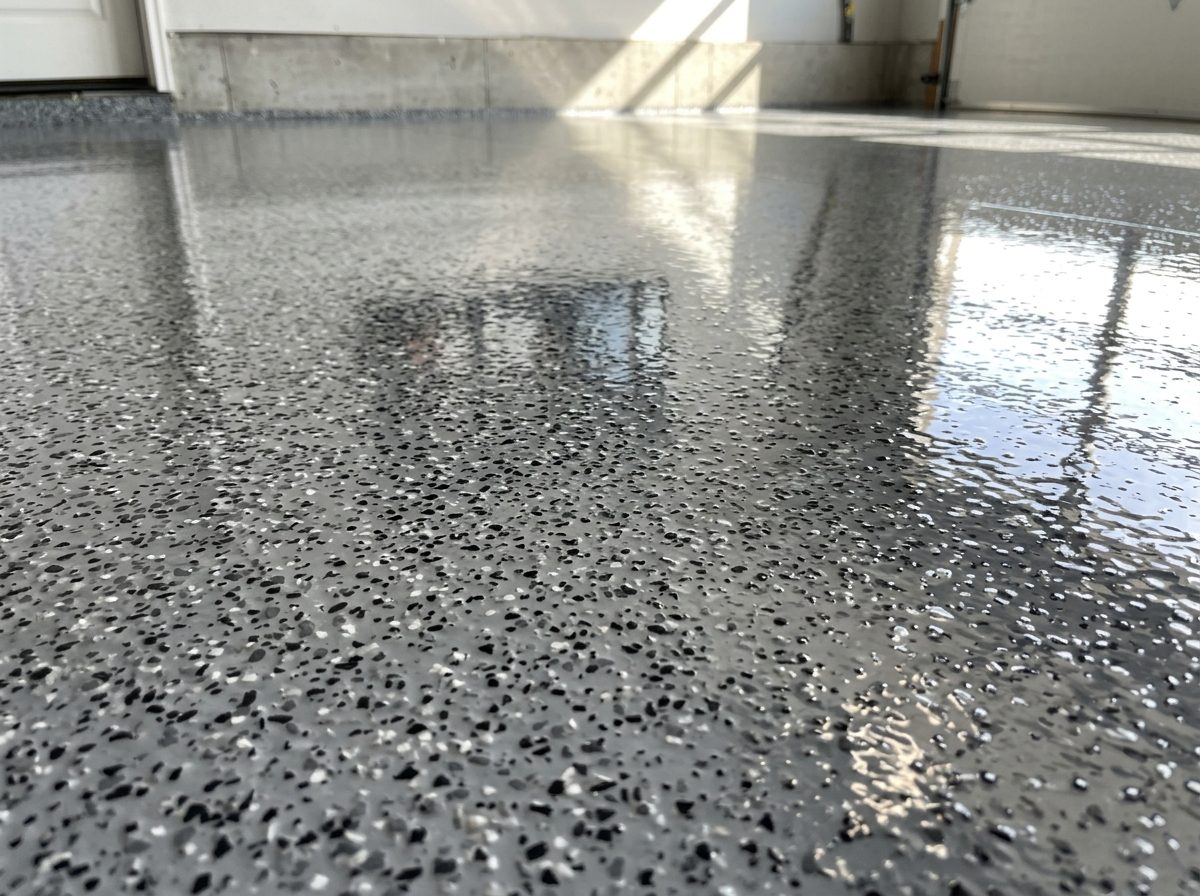
A full-flake system: base coat, broadcast, and clear topcoat.
Document the slab and how the garage is used
A Cedar City address alone does not establish a slab's moisture, profile, strength, cracking, contamination, or exposure. Record water and deicer exposure, sunlight at the door, vehicle use, cleaning chemicals, existing sealers, cracks, repairs, and any moisture evidence before comparing systems.
Ask what performance the product manufacturer documents for the proposed build and how surface preparation, testing, texture, cleaning, and maintenance affect that performance. This site does not promise a coating life or suitability for a particular slab.
What a proper installation includes
Preparation and installation requirements vary by slab and product. Ask each installer to put the following items in the written scope:
- Surface profile. Identify the preparation equipment, target profile, edge work, dust control, and the product manufacturer's requirements.
- Crack and spall scope. State which defects are repaired, which remain visible, and what movement or recurrence the warranty excludes.
- Moisture evaluation. State what is tested, the result, the applicable product limit, and any mitigation proposed.
- System build. Name each primer, base, broadcast, and topcoat product, coverage or thickness, texture, color, and slip-related trade-off.
- Cure and handoff. Put temperature limits, ventilation, foot and vehicle return times, cleaning, maintenance, and warranty terms in writing.
Duration and parking restrictions depend on slab condition, system, temperature, and cure requirements. Ask a provider you locate independently for a written prep and return-to-service timeline.
What does a garage floor coating cost in Cedar City?
Every honest answer starts with "it depends," because square footage, slab condition, repairs, access, and the system all move the number. Published internet estimates are orientation only and are not a Cedar City price schedule; request a written provider quote that lists prep, repairs, materials, taxes, and cure terms.
| Garage size | How price is confirmed |
|---|---|
| 1-car (~250 sq ft) | Provider quote after slab review |
| 2-car (~400–500 sq ft) | Provider quote after slab review |
| 3-car (~600–750 sq ft) | Provider quote after slab review |
| Basement / shop floor | Measured and quoted after slab review |
No official Cedar City price schedule is published here. A written provider quote is the only figure that applies to the specific floor.
Do not compare a contractor quote with a retail kit by package price alone. Compare surface preparation, tested slab conditions, named products, coverage or thickness, number of coats, repair scope, installation limits, labor, cure time, and written warranty. This site has no evidence that every retail or professional system will reach a particular service life.
Use this guide to prepare the location, scope, access, and timing questions for providers you locate independently. Call to record floor-coating project interest with the site owner. No coating contractor is currently attached, and the call does not provide an estimate, arrange service, or confirm provider response timing.
How to compare written proposals
Use these questions to compare written proposals from contractors you locate independently:
- How do you prep the slab — grinding or etching?
- What's the full system build — base coat, broadcast, and topcoat — and what topcoat chemistry do you use?
- How do you handle existing cracks and moisture?
- What does the warranty cover, in writing — and does it cover hot-tire pickup and peeling?
Ask each contractor to put its slab findings, proposed preparation, named products, installation limits, exclusions, and warranty terms in writing before engagement.
Cedar City garage floor questions, answered
How long does a garage floor coating take?
Duration and vehicle restrictions depend on slab condition, system, temperature, and cure requirements. Ask a provider you locate independently for a written prep, installation, and return-to-service timeline.
Can an independent provider coat an older, cracked slab?
No coating contractor is currently attached to this site. If one is selected later, verify its capabilities, service area, credentials, timing, and price directly before engagement; this call does not arrange service.
Can floors be installed in winter?
It depends on the exact product's published limits, slab and air temperatures, moisture, ventilation, and whether the space is enclosed or conditioned. Ask a contractor you locate independently to identify the products and show the applicable manufacturer documents before scheduling; this site cannot approve a winter installation.
What is hot-tire pickup?
"Hot-tire pickup" describes coating damage associated with parked tires. Product chemistry, bond, preparation, cure, temperature, vehicle use, and other conditions can matter. Ask the installer for the proposed manufacturer's relevant performance limits and the warranty's exact coverage and exclusions.
Epoxy or polyaspartic for a Cedar City garage?
Choose only after comparing the slab findings, intended use, sunlight, vehicle and chemical exposure, desired texture, installation conditions, cure window, named product data, and warranty. A Cedar City location or daily-driver label does not establish one correct system.
Can an independent provider serve areas outside Cedar City?
No coating contractor is currently attached to this site. If one is selected later, verify its capabilities, service area, credentials, timing, and price directly before engagement; this call does not arrange service.