Use this guide to prepare the location, scope, access, and timing questions for providers you locate independently. Call to record floor-coating project interest with the site owner. No coating contractor is currently attached, and the call does not provide an estimate, arrange service, or confirm provider response timing.
What "epoxy flooring" actually means
"Epoxy floor" is a marketing label, not a complete specification. A proposal may use one or more primers, base coats, decorative layers, or topcoats with different chemistries. Ask the contractor to identify every product, its manufacturer, application limits, required preparation, layer thickness, cure conditions, maintenance, and warranty. The polyaspartic guide provides additional comparison questions without declaring one chemistry better.
Retail kits and contractor-installed systems also vary. Compare the exact products and documented scopes rather than assuming either category has a fixed thickness, preparation method, service life, or performance advantage.
| Layer | What it does |
|---|---|
| Slab preparation | Which observations, tests, repairs, cleaning, and surface-profile method does the exact product require? |
| Primer or base coat | What named product is proposed, why was it selected, and what substrate and application limits apply? |
| Decorative layer | Is flake or another finish proposed, and what appearance, texture, coverage, and maintenance are specified? |
| Topcoat | What named product and published properties address the documented use and exposure? |
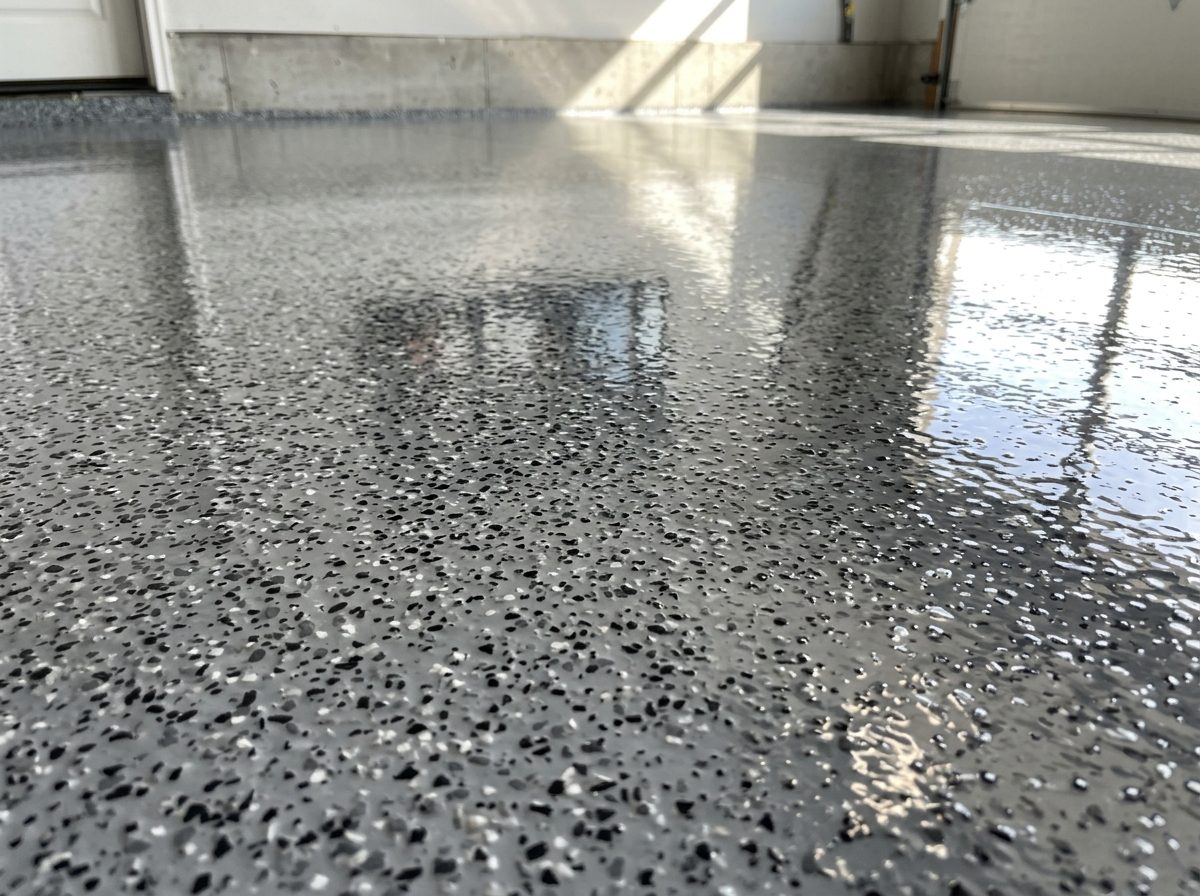
A full system: profiled slab, base coat, flake broadcast, clear topcoat.
Where epoxy floors work in Cedar City
Do not assign a coating system from the room label alone. For each space, give contractors the actual use and exposure and ask them to support the proposed products with the applicable manufacturer documents:
- Garages. Record vehicle use, sunlight, water, ice-melt or chemicals, tire contact, cleaning, traction, and return-to-service needs. The garage floor guide has a comparison checklist.
- Basements and interior slabs. Record moisture observations, drainage or water history, occupancy, ventilation, desired finish, cleaning, and manufacturer restrictions.
- Shops, warehouses, and commercial floors. Record traffic, equipment, loads, impacts, chemicals, sanitation, slip concerns, downtime, and maintenance. See the commercial floor guide.
If your slab is more decorative concrete than a coating candidate, the concrete coating options page compares stains, overlays, and coatings side by side.
Document the property's actual exposure
Ask how the proposal accounts for the slab's observed moisture, temperature during application, sunlight, water, salts, oils, chemicals, abrasion, impacts, traction needs, and cleaning methods. Do not assume that every Cedar City floor has the same conditions or that a generic coating label proves suitability.
Concrete Network's epoxy overview can supply general vocabulary, but it does not validate a product for this slab. Exact manufacturer documents, the contractor's inspection, and the written proposal should control.
What to document before installation
Preparation, repairs, products, application conditions, use, and maintenance can all affect results. Ask each contractor to put the following items in writing and connect them to the inspected slab and exact manufacturer instructions:
- Inspection and preparation. Observations, tests, contaminants, prior coatings, cleaning, repairs, selected preparation method, target profile, and verification.
- Cracks, joints, and spalls. Which conditions will be treated, left visible, honored through the system, excluded, or monitored—and with which products.
- Moisture. What was observed or tested, the test limits, and how the named products address or exclude those conditions.
- Decorative layer. Coverage, texture, appearance range, sample or mockup, slip characteristics, and maintenance if flake or another finish is proposed.
- Topcoat. Exact product, thickness, application limits, published properties, cure, cleaning, repairability, and warranty.
Project duration and the time before parking depend on slab condition, system, temperature, and cure requirements. Ask a provider you locate independently for a written timeline.
What does an epoxy floor cost in Cedar City?
No official Cedar City price schedule is published here. Quote inputs can include measured area, slab investigation and testing, preparation, repairs, named products, layer count and thickness, finish, access, protection, schedule, cure limits, travel, taxes, warranty, and exclusions. Internet estimates are orientation only, not a local quote.
| Space | What to confirm in writing |
|---|---|
| 1-car garage (~250 sq ft) | System, prep, repairs, and provider quote |
| 2-car garage (~400–500 sq ft) | System, prep, repairs, and provider quote |
| 3-car garage (~600–750 sq ft) | System, prep, repairs, and provider quote |
| Basement / shop floor | Measured and quoted after review of the slab |
A written provider quote should identify square footage, prep, repairs, coating system, travel or access charges, taxes, and cure/return-to-service terms. This site does not publish or guarantee a local price.
When comparing a contractor proposal with a retail kit, compare the exact product data, required preparation, application limits, layer thickness, cure conditions, equipment, maintenance, and warranty. This site does not claim a fixed lifespan or performance gap for either category.
How to vet any installer
Use these questions to compare written proposals from contractors you locate independently:
- How do you prep the slab — grinding or etching?
- What's the full system build — base coat, broadcast, and topcoat — and what topcoat chemistry do you use?
- How do you handle existing cracks and slab moisture?
- What does the warranty cover, in writing — and does it include hot-tire pickup and peeling?
Ask each contractor to put its slab findings, proposed preparation, named products, installation limits, exclusions, and warranty terms in writing before engagement.
Cedar City epoxy floor questions, answered
How long does an epoxy floor last?
Service life varies with slab moisture, preparation, product, build thickness, traffic, sunlight, maintenance, and installation quality. Ask each provider for product data and a written warranty rather than relying on a universal lifespan claim.
Is epoxy or polyaspartic better for a Cedar City floor?
Neither label establishes suitability. Compare the slab findings, intended use, exposure, installation conditions, exact products, published manufacturer properties, layer design, cure, maintenance, exclusions, and warranty. The polyaspartic guide provides a product-document checklist.
Can an independent provider put an epoxy floor over an old, cracked slab?
No coating contractor is currently attached to this site. If one is selected later, verify its capabilities, service area, credentials, timing, and price directly before engagement; this call does not arrange service.
Can epoxy floors be installed in winter?
It depends on the exact product's published limits, slab and air temperatures, moisture, ventilation, and whether the space is enclosed or conditioned. Ask a contractor you locate independently to identify the products and show the applicable manufacturer documents before scheduling; this site cannot approve a winter installation.
What is hot-tire pickup?
The term describes coating damage associated with vehicle-tire contact. Possible mechanisms and contributing conditions depend on the slab, preparation, products, application, cure, vehicle use, and environment. Ask each contractor and manufacturer how the exact proposed system addresses tire contact and what the warranty includes; this page does not diagnose a main cause or guarantee prevention.
Can an independent provider install epoxy floors outside Cedar City?
No coating contractor is currently attached to this site. If one is selected later, verify its capabilities, service area, credentials, timing, and price directly before engagement; this call does not arrange service.